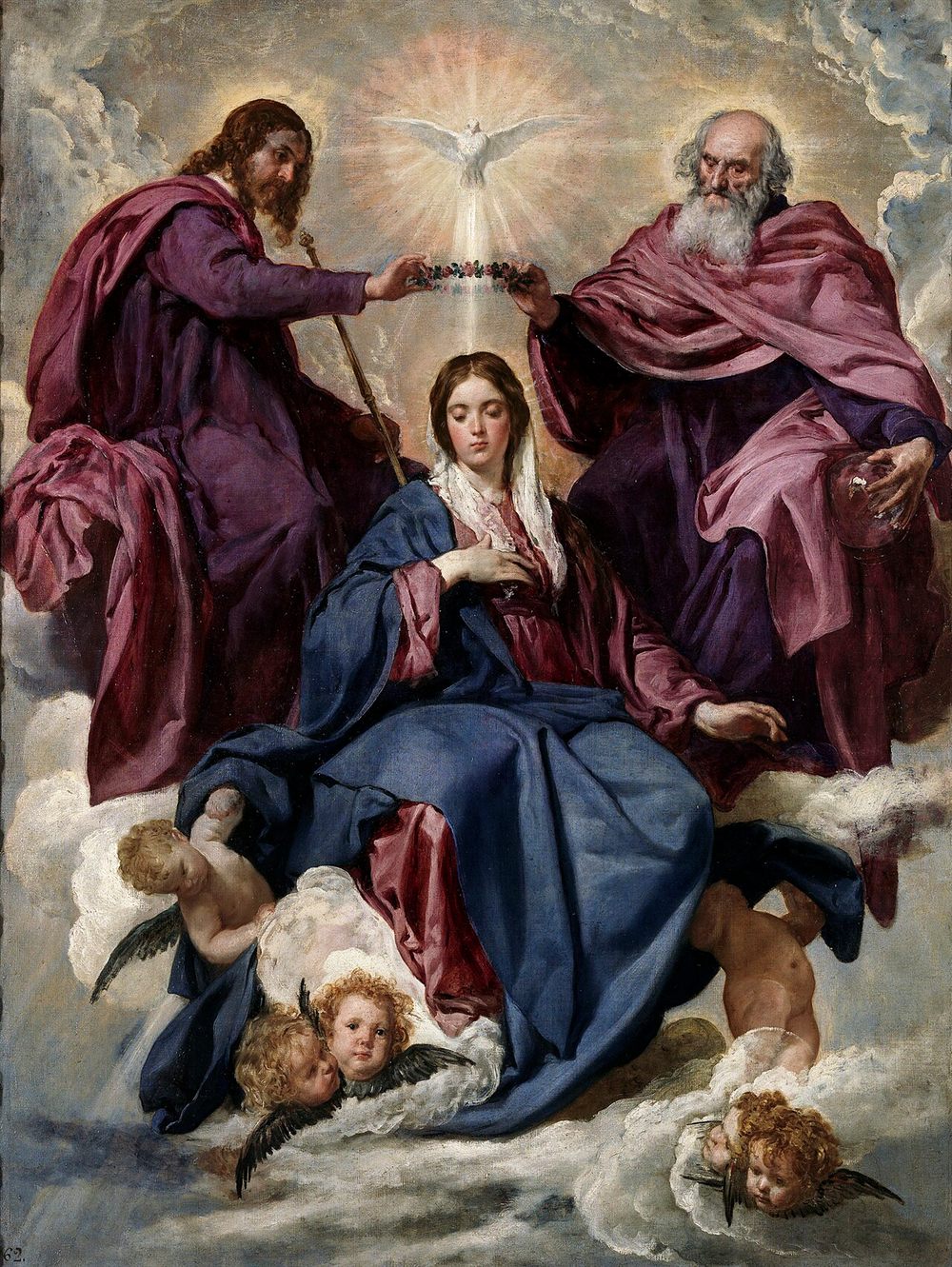
The Coronation of the Virgin by Diego Velázquez — the Blessed Virgin Mary crowned Queen of Heaven by the Father and the Son, with the Holy Ghost above
Diego Velázquez, The Coronation of the Virgin, c. 1635 — the Blessed Virgin crowned by the Father and the Son, the Holy Ghost above her.Museo del Prado, Madrid • Public domain

The Blessed Virgin Mary, Queen of Heaven

We who belong to the Ordo Militantium Reginae Caeli bear her name upon our lips and upon our seal. Reginae Caeli — Queen of Heaven. These are not merely beautiful words. They are a declaration, a proclamation, a battle standard planted firmly in the ground of eternity.

She is the woman of the Apocalypse, clothed with the sun, the moon beneath her feet, and upon her head a crown of twelve stars — the very image enshrined upon our shield. She is the Theotokos, the God-bearer, proclaimed at Ephesus in 431. She is the Immaculate Conception, solemnly defined by Blessed Pius IX in 1854. She is the Queen assumed body and soul into Heaven, as Pius XII defined in Munificentissimus Deus in 1950.

She is not a legend. She is not a symbol. She is a person, a mother — our mother — reigning in glory at the right hand of her Divine Son.

The Four Dogmas

The Church has defined four truths about Our Lady with her full solemn authority. They are not pious opinions offered for our consideration. They are dogmas — binding on every Catholic, and each one guards something about her Son.

I

Mother of God

Theotokos • Ephesus, 431

The Council of Ephesus condemned Nestorius and proclaimed Mary Theotokos, the God-bearer. The title defends Our Lord before it honours His Mother: He who was born of her is one Person, and that Person is God. To deny her the title is to divide Christ in two.

II

Perpetual Virginity

Semper Virgo • Lateran, 649

Virgin before, in, and after the birth of her Son. The Lateran Council of 649 stated it plainly, and the Fathers held it long before. Her virginity is not a detail of biography but a sign of the wholeness with which she gave herself to God, reserving nothing.

III

The Immaculate Conception

Ineffabilis Deus • 1854

Blessed Pius IX defined that from the first instant of her conception Mary was preserved free from every stain of original sin, by a singular grace and in view of the merits of Jesus Christ. She was not redeemed less than we are. She was redeemed more perfectly — preserved from the pit rather than lifted out of it. Four years later, at Lourdes, she gave her own name: I am the Immaculate Conception.

IV

The Assumption

Munificentissimus Deus • 1950

Pius XII defined that Mary, having completed the course of her earthly life, was assumed body and soul into heavenly glory. Corruption had no claim on the flesh that bore the Author of Life. What happened to her is what is promised to us: not a soul set loose from its body, but a body raised.

Her Queenship

In 1954 Pius XII issued Ad Caeli Reginam and established the feast of the Queenship of Mary. He was not inventing a devotion; he was ratifying one the faithful had held for fifteen centuries, in the Marian antiphons, in the fifth glorious mystery, in the crown of the Rosary itself.

Her queenship follows from her motherhood. Christ is King by nature, as God, and by conquest, as the Redeemer who bought us back. She is Queen by relation to Him — Queen Mother in the manner of the gebirah of the kingdom of Judah, who sat at the king's right hand and carried the petitions of his people to him. That is the office she holds now, and it is why we bring her ours.

Saint John saw her: a woman clothed with the sun, and the moon under her feet, and on her head a crown of twelve stars. The dragon stood before her, waiting. It is the image on our shield, and it is not a decoration. It is a description of the war we were enlisted into.

Regina Caeli

Of the four Marian antiphons the Church sings through the year, Regina Caeli belongs to Paschaltide. From Easter to Pentecost it replaces the Angelus, and it is sung standing, for it is the prayer of a people whose Lord is not in the tomb.

It is a short prayer and it is almost entirely about her Son. Regina caeli, laetare — Queen of Heaven, rejoice — quia quem meruisti portare, resurrexit sicut dixit. For He whom thou didst merit to bear has risen, as He said. Four lines, and three of them are about the Resurrection.

That is the name this Order carries, and it sets the shape of everything we do. We are not devoted to her instead of Him. We are devoted to her because of Him, and she has never once kept for herself anything we brought to her. She hands it on.

The prayers of the Order, this antiphon among them, are set out on the prayers page.

The Devotion She Asks of Her Soldiers

What does a Queen expect of her soldiers? Loyalty. Constancy. The willingness to stand when all around are kneeling before the idols of the age. She does not ask for fair-weather devotion. She asks for hearts that are hers — wholly, entirely, without reservation.

The members of this Order are bound to the daily Rosary and to the First Saturdays kept devoutly, and to the works of mercy that flow from a Marian heart. These are not heavy burdens laid upon the unwilling. They are the ordinary shape of a life given to her.

Under her mantle we take refuge. Under her banner we march. Our devotion to her is the heart and soul of this Order, and everything else we do proceeds from it.

"The salvation of the world began through Mary and through Mary it must be accomplished." — St. Louis de Montfort

The Motto of the Order

Our motto is the oldest known prayer to Our Lady, older than the creeds men quarrel over, found upon a scrap of Egyptian papyrus from the third century: Sub tuum praesidium confugimus, Sancta Dei Genetrix. Under thy protection we take refuge, O Holy Mother of God.

Christians were praying those words while the persecutions were still running. We pray them now for the same reason they did.

Serve the Queen

The Order is open to practicing Catholics who feel called to serve Our Lady and defend the Traditional Faith.